Louis–Claudia relationship
A History of the Vampire in Popular CultureThe Louis–Claudia relationship is a tragic vampire-family bond shaped by grief, manipulation, and the impossible contradiction of an adult consciousness imprisoned in a child’s body. Louis’s attempt to escape human sorrow by accepting transformation from Lestat de Lioncourt leads indirectly to Claudia’s creation, while Lestat uses the child as a gift and a bargaining instrument. Their attachment gives Interview with the Vampire its most unsettling emotional structure: Claudia is at once Louis’s companion, daughter-like dependent, and fellow immortal, yet her continued existence exposes the moral damage inflicted by the men who made her.
Formation Through Grief
Louis de Pointe du Lac begins as a twenty-four-year-old widower devastated by the deaths of his wife and child. He neglects his previously successful plantation and deliberately places himself in danger, hoping that death might reunite him with his lost family. Lestat de Lioncourt recognizes Louis as a potential ally and offers to turn him into a vampire. Louis accepts because he wants release from torment, but immortality does not provide the escape he seeks; it traps him in an eternity of suffering and leaves him morally repelled by the necessity of attacking human beings.
Claudia enters this damaged emotional world after Louis feeds from her orphaned body in a moment of desperation. Lestat immediately exploits the situation by turning her into a vampire and presenting her to Louis as a gift. The gesture appears to create a family, but its underlying purpose is political: Claudia is a pawn in Lestat’s effort to keep Louis attached to him. Her creation therefore joins intimacy to coercion from the beginning. Louis receives a companion who seems to answer his loneliness, while Lestat converts that need into another form of control.
An Immortal Child and an Adult Mind
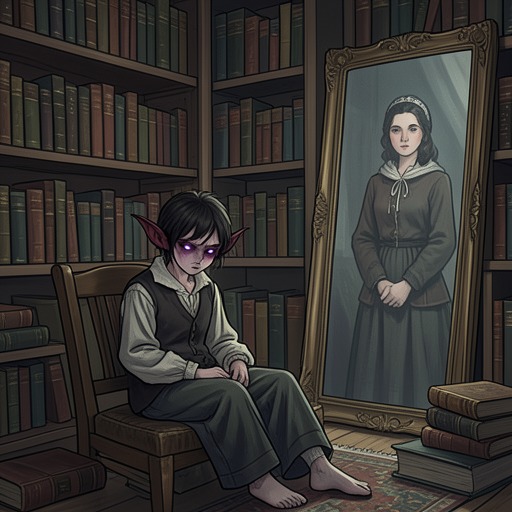
Claudia’s defining condition is the division between her mental development and her physical form. She remains outwardly prepubescent while acquiring the intellect, desires, and resentments of an adult woman. The result is not simply a supernatural variation but a sustained contradiction: a mature consciousness is permanently enclosed within a child’s body. The relationship with Louis is consequently parental in appearance but unstable in practice, because Claudia cannot grow into the adult identity that her mind increasingly demands.
This contradiction gives the family structure its uneasy tone. Modern vampire culture often presents vampirism as inherently sexual, yet Claudia’s immortal mind and childlike body make that association ethically disturbing. Her position resembles that of Eli in Let the Right One In, another character whose apparent childhood conceals an adult or otherwise radically different existence. Claudia cannot be understood only as an innocent child or only as an adult predator; the power of the character lies in the collision between those categories.
The film adaptation intensifies the discomfort through Kirsten Dunst’s performance at the age of eleven. She received a Golden Globe nomination for Best Supporting Actress in 1995 for portraying an adult woman confused and constrained by an immortal child’s body. Dunst later described the required intimacy with Brad Pitt’s Louis as disturbing because she regarded him as an older-brother figure, a reaction that underscores how sharply the production’s acting demands collided with the character’s fictional status.
Dependency, Manipulation, and Moral Conflict
Louis and Claudia are bound by shared dependence, but they do not occupy equal positions within the relationship. Louis retains empathy and is repelled by killing humans, whereas Lestat feels no comparable moral restriction. Claudia therefore becomes connected to Louis’s conscience as well as to his need for companionship. Her presence gives his endless life a domestic and emotional form, but it also makes the violence of that life impossible to ignore.
Lestat’s role is crucial to the relationship’s tragic design. He turns Claudia not because the child’s welfare requires it, but because her existence can be used to secure Louis’s continued attachment. The apparent family is thus built around a transaction: Lestat offers Claudia to Louis as compensation and emotional leverage. Louis may love her, but the conditions of her making remain exploitative, and the affection that follows cannot erase the fact that she was created as an instrument of another vampire’s power.
Claudia eventually becomes the force that undoes the household. Her uncontrollable nature and growing mental independence make her impossible to contain within the role of grateful child or decorative family member. The same creation that allows Louis and Lestat to imitate domestic stability produces a rival consciousness capable of exposing the instability beneath it. Her development turns the household’s emotional dependence into conflict, making Claudia the point at which Lestat’s manipulation and Louis’s complicity become dangerous to everyone involved.
Tragic Significance
The relationship’s central tragedy is that Claudia is denied both ordinary mortality and ordinary maturation. Louis sought death as an escape from grief, but the transformation he accepted prevents death from ending his pain; Claudia, by contrast, is denied even the possibility of growing older. Their bond therefore links two different forms of captivity. Louis is trapped in immortal remorse, while Claudia is trapped in a body that permanently misrepresents the age and powers of her mind.
Claudia’s presence also transforms the vampire family from a comforting metaphor into a structure of concealed violence. She can be loved, protected, and treated as a daughter-like companion, yet she was created through predation and remains part of a system that feeds on human beings. The relationship refuses a simple division between good family and bad monster. Louis’s empathy does not free Claudia from the consequences of his choices, and Lestat’s cruelty does not prevent the household from containing genuine attachment.
In this sense, Louis and Claudia embody the broader development of vampire fiction. Earlier figures such as Varney could become sympathetic by struggling against murderous instincts, while Carmilla made predatory intimacy and socially forbidden desire central to the vampire’s appeal. Later portrayals increasingly allow vampires to be sympathetic, ethical, or openly integrated into human society. Louis and Claudia belong to the darker stage of that evolution: they are emotionally legible without becoming morally safe. Their relationship makes immortality appear not as liberation but as an inheritance of grief, power, and unresolved responsibility.